
Articles
April 2026
“Authenticity or Self-Centeredness?”
Authenticity connects — self-centeredness separates. Explaining the confusion that divides our society.

Individuality, egoism, and egocentrism are often used interchangeably in everyday conversations, but they describe fundamentally different attitudes toward oneself and others.
Individuality says, “I am myself, and you are yourself, and we both matter.”
Egoism says, “My needs come first.”
Egocentrism says, “My perspective is the central one.”
In our modern society, these three concepts are frequently confused. This misunderstanding contributes to growing social tensions, divisions within humanity, and much of the polarization and conflict we increasingly see around us.
At the same time, self-centered behavior is often justified as “just being yourself,” leaving sensitive people speechless or even flabbergasted. While the difference between these concepts may seem subtle at first, it is actually far-reaching.
Recognizing this distinction can help create more clarity and balance in how we relate to one another. Let me explain…
Individuality…
… is the ability and willingness to be authentically oneself. It involves recognizing one’s own thoughts, values, emotions, and personality, and expressing them honestly without conforming to external expectations. Individuality is rooted in self-awareness and inner confidence. A person with strong individuality does not need to dominate or compete with others; they simply stand in their own identity.
Importantly, individuality naturally includes respect for others.
When someone understands their own uniqueness, they are more open to accepting differences in others. Individuality, therefore, supports compassion, empathy, creativity, and cooperation. It allows people to contribute their distinct perspectives while still feeling connected to a larger community. In this sense, individuality strengthens relationships rather than weakening them.
Egoism…
… on the other hand, places one’s own needs, desires, and benefits above those of others. An egoistic person tends to prioritize personal gain, recognition, or comfort, sometimes without considering how their actions affect those around them.
While individuality is about authenticity, egoism is about advantage. The focus shifts from “being oneself” to “putting oneself first.”
Egoism does not necessarily mean intentional harm, but it often leads to imbalance. Decisions may be guided primarily by self-interest, and the well-being of others becomes secondary. Over time, this can create distance, competition, and reduced trust in relationships. Where individuality invites mutual respect, egoism often narrows the perspective to personal benefit.
Egocentrism…
…is slightly different from egoism. While egoism focuses on self-interest, egocentrism refers to a limited ability to see things from another person’s perspective. An egocentric individual tends to view the world primarily through their own experiences, assumptions, and emotions. They naturally assume that their viewpoint is the central or most obvious one.
Egocentrism can appear as difficulty listening, misunderstanding others, or assuming that everyone thinks and feels the same way. This can lead to communication problems and conflict.
In contrast, individuality encourages openness and curiosity about different perspectives.
The confusion between these three concepts plays an important role in today’s social climate. When individuality is mistaken for egoism, authentic self-expression may be discouraged. At the same time, egoistic or egocentric behavior is sometimes defended as a sign of independence or self-confidence.
This blurring of boundaries weakens compassion, empathy, mutual respect, and constructive dialogue.
Individuality says, “I am myself, and you are yourself, and we both matter.”
Egoism says, “My needs come first.”
Egocentrism says, “My perspective is the central one.”
When individuality is understood and lived, it strengthens connection, encourages diversity, and creates space for mutual respect. In contrast, egoism and egocentrism often lead to separation, misunderstanding, and conflict, something increasingly visible in today’s world.
Clarifying the distinctions of individuality, egoism, and egocentrism is more than an intellectual exercise; it is an invitation.
Each of us has the opportunity to recognize these patterns in ourselves and others and in our interactions. By valuing individuality, our own and that of others, we help create an environment where authenticity is welcomed, compassion and empathy can grow, and respect becomes the natural foundation of human connection.
Change does not always begin with grand gestures. It often starts quietly, with understanding, with awareness, and with the conscious choice to respond rather than react.
In doing so, we contribute to a more balanced society, one where differences are not threats but strengths, and where authenticity, compassion, empathy, and respect can truly exist together.
You can choose to be an example! Then watch the ripple effect quietly spreading outward, touching hearts, shaping relationships, and gently making the world a little kinder.
Much love, Anja
December 2025
✨ Pause and Come Back ✨
As empaths, we often move through the world like open channels, feeling deeply, sensing subtly, and sometimes carrying more than we realize.
One of the greatest challenges on this path is learning to tell the difference between what’s ours and what belongs to someone else. When your body aches, your mood shifts, or fatigue sets in, how can you know what’s truly yours to heal?
Being empathetic, how do you know if the physical symptoms you feel are truly your own or if you’ve unknowingly picked them up from someone else?
Every empath faces this question at some point. You may wake up with an ache, tension, or fatigue that seems to appear out of nowhere. Perhaps a heaviness in your chest after a conversation, or a sudden headache that doesn’t quite “feel like yours.”
These moments can be confusing. Yet, they’re also invitations to pause, to listen, and to come back to yourself.
 When uncertainty arises, the key is simple yet powerful: pause and return to your own energetic center.
Ground yourself in the present moment. Take a deep breath in and out. Feel your body, your heartbeat, your weight, the air touching your skin. Maybe even make yourself a comforting cup of tea or coffee. These small, grounding rituals remind your nervous system that you are here, safe, and present in your body.
Once you feel more centered, begin to gently explore the sensation.
1. Ask Your Body Directly
Place your hand over the area of discomfort and ask softly, “Is this mine?”
Don’t analyze or rationalize. The answer often comes as a subtle sense or an inner knowing, a feeling of heaviness or lightness, a quiet whisper of truth. Your body is wise and honest when you learn to listen.
2.Remember Who You Interacted With
Think back over the last few hours or days.
Did anyone you spoke to mention pain, illness, or exhaustion? Did you feel pity for someone you saw recently? Sometimes, just letting your eyes linger on a person in distress, even for a brief moment, can create an energetic bridge. As empaths, our open hearts make us natural receivers of other people’s unspoken emotions and discomfort.
3.Think of Your Connections
Is there anyone in your circle, in your family, amongst your friends, or acquaintances, who is currently experiencing something similar to what you’re feeling?
Energy travels through thought, emotion, and memory. For empaths, it can be enough for someone to think about you with intention for their energy to reach you. Awareness of these invisible threads helps you recognize when what you’re feeling might not originate within you.
4.Check with Color
Try this revealing yet straightforward visualization:
Give yourself a color—perhaps a soft blue, golden white, or whatever feels right—and imagine everyone else’s energy as a different color. Now, visualize the area where you feel discomfort. What color does it have?
If it’s in your own hue, it may be your body asking for care. If it shows up in someone else’s color, you’ve likely absorbed energy that isn’t yours.
Release and Return
 If you discover that the energy belongs to someone else, don’t hold judgment or frustration; release it with love and neutrality.
Visualize the energy leaving your body and flowing gently back to its rightful source, like returning a misplaced belonging. You might imagine it dissolving into light, carried by compassion and peace. The goal isn’t to push away, but to return what isn’t yours with kindness.
Afterward, take another deep breath. You’ll likely notice a sense of lightness, relief, or renewed clarity. That’s the feeling of coming home to yourself.
Energy Maintenance Is Essential
For empaths, energy maintenance isn’t a luxury, it’s essential. Just as we brush our teeth or wash our hands, we must also cleanse and care for our energetic field. The more regularly you “pause and come back,” the easier it becomes to tell the difference between your own sensations and what you’ve absorbed from others.
With practice, you’ll begin to live from a grounded, radiant core, openhearted yet protected; compassionate, yet sovereign.
Remember, whenever the world feels heavy, pause and come back.
Much love, Anja
October 2025
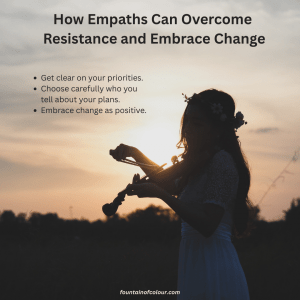
“How Empaths Can Overcome Resistance and Embrace Change”
As an empath, change can feel like a great challenge because you might not only carry your own doubts and fears, but you also sense these emotions of others as if they were your own. That is why it is so important to be mindful of whom you tell about your plans for change. Not everyone can meet your vision with encouragement. Some may unconsciously project their fears onto you, trying to help and keep you in a safe place.
Protecting your energy and choosing carefully who you share with is the first step toward creating a healthy space for your transformation.
 In today’s modern world, change is mainly positive. Growth, learning, and adaptability open doors to opportunities and freedom. Fear of change is based on old-fashioned wiring. It is simply an ancient survival instinct that no longer serves us as it once did.
Our brains are designed to keep us safe by holding us to the familiar, even when the familiar is no longer working for us. So, be aware that when you want to shift a habit or thought pattern, or change your life, resistance will arise. This is a normal subconscious reaction to stepping into something new.
Resistance in Disguise
Also, know that resistance can take on fabulous disguises. Procrastination is a phenomenon that probably everybody has experienced more than once. Everything else seems to be more important or needs to be done before you start making any changes. When you are aware that procrastination is just a reaction to change, deal with this consciously and clarify your priorities.
After getting clear on your priorities, you will also realize that confusion wants to keep you in your familiar space and situation and safe from the uncertainty that comes with change. When your tasks are too many, you don’t know where to start, you think you don’t know enough to share your knowledge or take a leap forward and change your life, make sure you remember your priorities.
Since empaths often want to do things “just right,” perfectionism can also come up to delay or block your progress. Perfectionism supports overthinking. Your mind will circle endlessly, convincing you that you must have the perfect plan before you can begin working on changing your life. Perfectionism also supports overeducation in pursuit of the ideal result. So, if you find yourself reading, studying, researching, planning, and preparing before you think you can attend to your priority, know that it is just another attempt of your brain to keep you in your comfort zone, this supposedly safe place.
Another trick of your brain is getting busy with unimportant tasks and forgetting essential meetings, calls, or appointments. You might think to yourself: ‘How could I forget this?’ Be sure that you didn’t just ignore. It is your inner resistance that grew into something like self-sabotage because you try so hard and don’t stop working on change. Your brain will do anything to keep you safe.
Resistance is misunderstood, intangible, and can wear many disguises. None of the above are personal flaws. They are simply the subconscious way of resisting change.
Conscious Empowerment
But here’s the empowering truth: all of this can be overcome. You don’t have to wait for motivation to strike. You can begin right now, one small step at a time:
- Get clear about your priorities,
- Be conscious about who you tell about your plans
- Change is positive.
When you are bothered by procrastination, confusion, perfectionism, overthinking, overplanning, overeducation, forgetfulness, or drama without a recognizable reason, get back to your priorities and take action. Any action will do. Breathe in and out deeply, stay present, and resist the urge to give up. Don’t do ‘nothing’ and let resistance win.
Science reminds us that it takes only about thirty days of consistent effort to form a new habit. A single month of dedication is often enough to rewire your brain in a way that supports the life you truly want.
Change is not the enemy; it is the path to freedom. Every act of persistence is a declaration that your future matters more than your fears.
Conclusion
Yes, resistance will appear, but it is only an echo of outdated wiring. You are stronger than that echo. You are capable of transformation. One conscious choice, one step forward, one day at a time, you can create the life you long for.
By consciously overcoming old wiring, you will create a brighter future for yourself that will have a ripple effect on everyone around you.
You are a sensitive soul on your way to wholeness!
Much love, Anja